

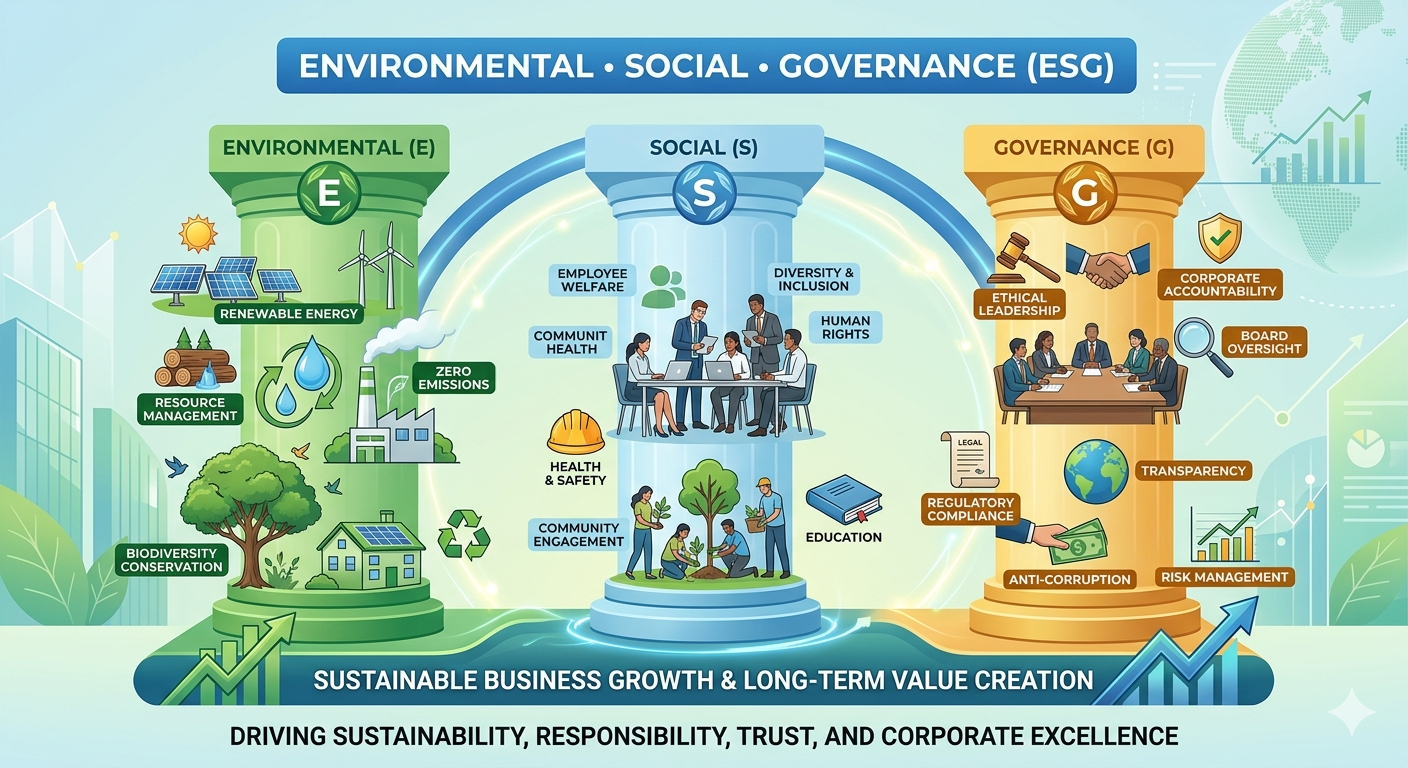
What are ESGs?
In the modern marketplace, commercial viability is no longer judged solely by revenue, profit, and market value. Governments, regulators, communities, and global investors increasingly evaluate companies on their Environmental, Social, and Governance (ESG) performance. Fundamentally, ESG serves as a framework to measure whether an organization operates responsibly, ethically, and sustainably.
For corporate executives, directors, and compliance officers, ESG is not a superficial corporate social responsibility initiative. It is increasingly becoming a business imperative that affects investment opportunities, access to finance, regulatory compliance, operational resilience, and corporate reputation.
Environmental (E): Managing Ecological Impact and Climate Risk
The environmental component focuses on how commercial operations affect the natural environment. Regulatory oversight is intensifying globally and locally, making environmental mismanagement a severe financial and operational liability.
Key considerations include the following:
- Climate change and greenhouse gas emissions;
- Pollution of air, land, and water resources;
- Waste management practices;
- Energy consumption;
- Sustainable use of natural resources.
Businesses operating in sectors such as mining, oil and gas, manufacturing, agriculture, construction, and real estate face particularly significant environmental risks.
Environmental Risks Businesses Should Monitor
- Climate Change Exposure
Climate change is already affecting business operations globally and within Ghana. Flooding, coastal erosion, unpredictable rainfall patterns, and extreme weather events can disrupt supply chains, damage infrastructure, and increase operating costs.
Businesses should assess the following:
- Climate-related operational risks;
- Energy consumption patterns;
- Carbon emissions;
- Business continuity and resilience strategies.
- Pollution and Environmental Impact
Environmental incidents can expose companies to significant financial and reputational risks. Activities that contaminate rivers, land, forests, or air quality may trigger regulatory action, community opposition, and operational disruptions. Industries with substantial environmental footprints should regularly evaluate their environmental management systems and adopt measures that minimize environmental harm.
- Waste Management and Resource Efficiency
Improper disposal of industrial, chemical, electronic, or plastic waste can create serious liabilities.
Businesses should establish clear waste management procedures and promote resource efficiency through the following:
- Waste reduction initiatives;
- Recycling programmes;
- Water conservation;
- Energy efficiency measures.
These practices not only reduce risk but can also generate operational cost savings.
Social (S): Human Capital, Human Rights, and Community Stakeholders
The Social component focuses on how an organisation manages relationships with employees, customers, suppliers, communities, and other stakeholders.
Key areas include:
- Labour rights and fair employment practices;
- Workplace health and safety;
- Diversity, inclusion, and equal opportunity;
- Human rights protection;
- Community engagement and stakeholder relations.
Social Risks Businesses Should Monitor
- Employee Welfare and Labour Practices
Organizations that fail to provide fair wages, safe working conditions, and respectful workplaces may face workforce instability, legal challenges, and reputational harm.
Business leaders should prioritize the following:
- Employee health and safety;
- Fair employment practices;
- Training and development;
- Workplace inclusion and respect.
A strong workplace culture contributes directly to productivity, employee retention, and organisational performance.
- Human Rights and Supply Chain Risk
Businesses are increasingly expected to monitor not only their own operations but also those of suppliers and contractors. Issues such as child labour, forced labour, exploitation, and unsafe working conditions within supply chains can expose organizations to significant reputational and commercial risks.
Companies should conduct regular assessments of supply chain practices and implement standards that align with international expectations.
- Community Relations
Businesses that operate without meaningful engagement with affected communities may encounter resistance, protests, operational disruptions, and reputational challenges.
Constructive stakeholder engagement can help organizations:
- Build trust;
- Reduce conflict;
- Improve project sustainability;
- Strengthen social license to operate.
This is particularly important in sectors such as mining, infrastructure, agriculture, and large-scale development projects.
Governance (G): Integrity, Oversight, and Internal Controls
Governance is the operational anchor of the ESG framework, dictating how a corporation is directed, controlled, and supervised. Strong governance systems ensure that a company is transparent, accountable, and legally compliant.
Governance Risks Businesses Should Monitor
- Transparency and Accountability
Investors and stakeholders expect companies to provide accurate information regarding financial performance, risks, operations, and strategic decisions. Weak transparency can undermine investor confidence and damage credibility. Boards and management teams should therefore promote a culture of accountability and ensure robust reporting processes.
- Corruption and Financial Crime
Corruption, fraud, bribery, and other forms of misconduct remain significant risks for many organizations.
Businesses should implement the following:
- Anti-corruption policies;
- Internal controls;
- Employee training programmes;
- Reporting mechanisms;
- Regular compliance monitoring.
Strong anti-corruption measures help protect both corporate reputation and long-term profitability.
- Board Oversight and Risk Management
Boards play a crucial role in overseeing ESG risks and ensuring that sustainability considerations are integrated into corporate strategy.
Effective boards should:
- Monitor emerging ESG risks;
- Establish clear accountability structures;
- Review compliance performance;
- Ensure appropriate risk management frameworks exist.
ESG should be treated as a strategic business issue rather than a standalone compliance exercise.
Business Implications and Emerging Trends
Regulatory frameworks are increasingly mandating systematic internal mechanisms to uncover corporate malfeasance. Statutes like the Anti-Money Laundering Act require robust internal controls to actively detect fraud and bribery, while the Whistleblower Act, 2006 (Act 720) mandates clear protection pathways for employees who expose wrongdoing. Modern governance requires clear transparency: organizations must present accurate financial reporting, comprehensive risk disclosures, and honest operational metrics.
Why ESG Matters to Businesses
Businesses must prioritize ESG factors because investors and financial institutions increasingly use them to evaluate funding eligibility, meaning poor ESG performance can restrict access to capital and result in less favorable financing terms.
Simultaneously, regulators worldwide are tightening requirements around environmental sustainability, climate disclosures, and corporate accountability. Failing to proactively align with these evolving regulatory frameworks and international reporting standards exposes companies to significant compliance risks, including legal investigations, financial penalties, operational restrictions, and the potential suspension of essential business licenses.
Key Takeaways for Businesses
- ESG is now a strategic business issue, not merely a compliance requirement.
- Investors and lenders increasingly consider ESG performance when making funding decisions.
- Environmental risks, including climate change and pollution, can have significant financial and operational consequences.
- Strong labour practices, human rights protections, and community engagement enhance organizational resilience and reputation.
- Effective governance, transparency, and anti-corruption measures are essential for long-term business success.
- Boards and senior management should integrate ESG considerations into corporate strategy and risk management frameworks.
- Businesses that proactively embrace ESG principles are better positioned to attract investment, strengthen stakeholder trust, and achieve sustainable growth.
By: Maria Mbroba Biney
